
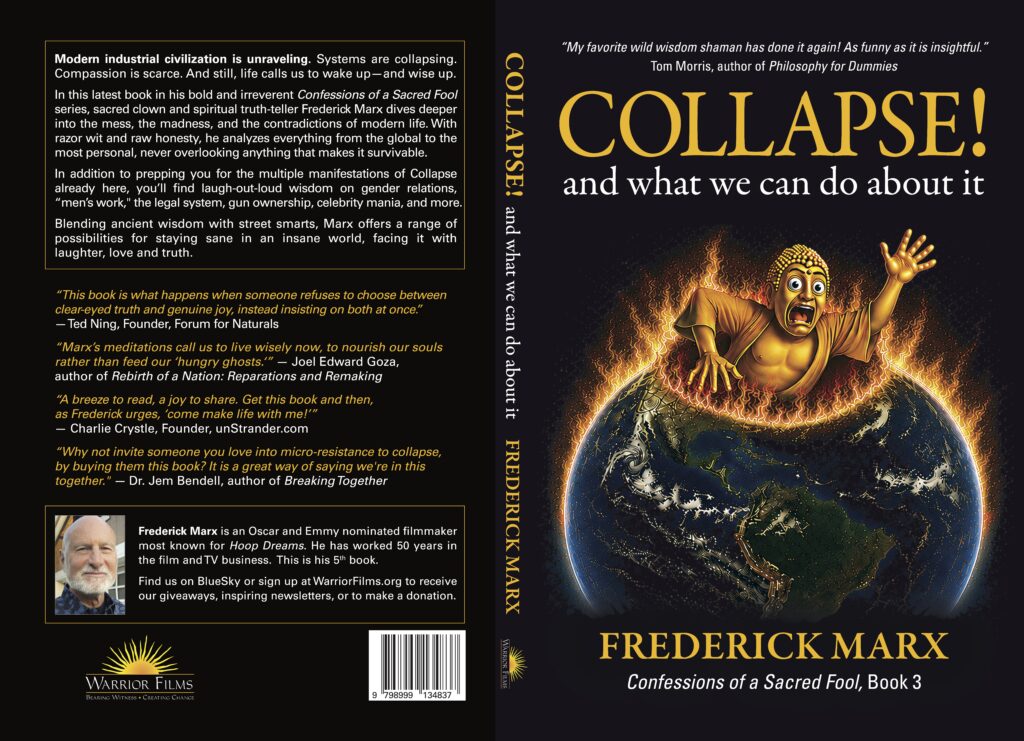
I’d love to tell you that my fifth book, Collapse! And What We Can Do About It, is arriving at a terribly inconvenient time, making its subject matter out of date. Unfortunately, the news has been very accommodating.
“Humanity dies when belief systems are placed above the cares of individuals.”
On November 16, Russian strikes hit two bridges in Kyiv. The city’s mayor reported disruptions to electricity and water and damage to the subway. After visiting Ukraine last spring to screen films, I read that news and thought about the people I met there. An outage is one line in a news story. For the person who turns on the tap and nothing comes out, it can be the whole damn day. For people who are having the entire power system of their country bombed, it can be the whole damn winter. Reuters · My reflections from Ukraine

The next day, a global food crisis report found that acute food insecurity remained very high across the 39 countries and territories it had data for. Conflict and extreme weather were among the main drivers, and higher prices for food and fertilizer made things worse. On November 22, COP31 UN climate talks in Turkey ended without an overarching agreement after disputes over fossil fuels and financing. World Food Programme · Associated Press
Around the same time, a Federal Aviation Administration outage grounded departures across the country, Microsoft 365 service was disrupted, and an internal National Security Agency network went offline. JPMorgan Chase and United Airlines had disruptions of their own. U.S. officials said they found no evidence that the outages were connected or caused by cyberattacks. Separately, on November 21, the Associated Press reported that the FBI was investigating a suspected hack of a national law enforcement database that includes records on missing people. The scope is still unclear. I think about how much of an ordinary day depends on systems most of us never see. You find out how much you count on them the minute you need to get home or start looking for someone who hasn’t come home. Reuters · CBS News · Associated Press
Seemingly massive stories, all in the same week. Yet probably registered as nothing more than a few seconds on all of our daily doom scrolls. I keep coming back to one question: what happens to the people who have the least room to absorb the next blow?
That question is part of why I wrote my fifth book, Collapse! And What We Can Do About It. It’s a continuation of Confessions of a Sacred Fool series which means I include gazes simultaneously directed outward and inward. Otherwise, I’d spend an entire book pointing fingers, and frankly, I’d enjoy that a little too much.
I wrote about what happens when the things we count on give way, from the systems that keep the lights on, to the governments that govern our lives, to the stories we tell ourselves about who we are. I’m interested in what acceptance makes possible. Once I recognize that something has changed, I can spend a lot less energy insisting on having it back the way it was. It frees up a lot of energy to call a struggling friend and ask how they’re doing. I can focus on doing the maximum possible good within whatever those new constraints are.
“My favorite wild wisdom shaman has done it again! This is classic Frederick Marx, as funny as it is insightful. May the complete collapse of the modern world give you enough time to read this book!”
Tom Morris, author of Philosophy for Dummies
In the foreword, DS Moss writes, “This book is for the one still standing in the rubble with the brick in both hands.” I love that image. I know what it’s like to stand there holding the brick long after I’ve forgotten what I meant to do with it.
If that sounds familiar, I hope you’ll give the book a read. And if someone came to mind while you were reading this, please share. You might have a good conversation.
Get Collapse! And What We Can Do About It on Amazon
P.S. If you read the book and feel like leaving an honest review on Amazon, I’d be grateful. I’d love to hear what stayed with you, and in fact for the first 10 folks to leave a review, reply with a screenshot of your review on Amazon, and we’ll provide you with a FREE COPY OF ANY OF OUR OTHER E-BOOKS in pdf form, just in time for the holidays.
What advance readers are saying
“Marx brings humor, hard-won wisdom, and a fierce love of life to the burning question of whether, as the world around us comes apart, we have to fall apart with it. He refuses both denial and despair, and offers something far more useful: a way to meet this moment awake, undefended, and fully alive. Let’s go!” Vinny Ferraro, Founder, Big Heart City, San Francisco
“Collapse is real, and denying it causes problems to escalate. But you can’t confront it head-on without frightening yourself to death. You need to approach it with humor and crazy wisdom, which Marx does with abundance. It may be the most important work that men alive today must engage.” Jed Diamond, PhD, Founder of MenAlive, author of 12 Rules for Good Men
“Frederick Marx doesn’t flinch from Collapse — he dances with it. This book is what happens when someone refuses to choose between clear-eyed truth and genuine joy, and instead insists on both at once. Equal parts wake-up call and permission slip to laugh, it’s the kind of medicine we need right now.”
Ted Ning, founder of Forum for Naturals
“Part of the collapse is becoming a society which doesn’t read books and can’t laugh at our foolishness. So why not invite someone you love into micro-resistance to collapse, by buying them this book? It is a great way of saying we’re in this together.”
Dr. Jem Bendell, author of Breaking Together