
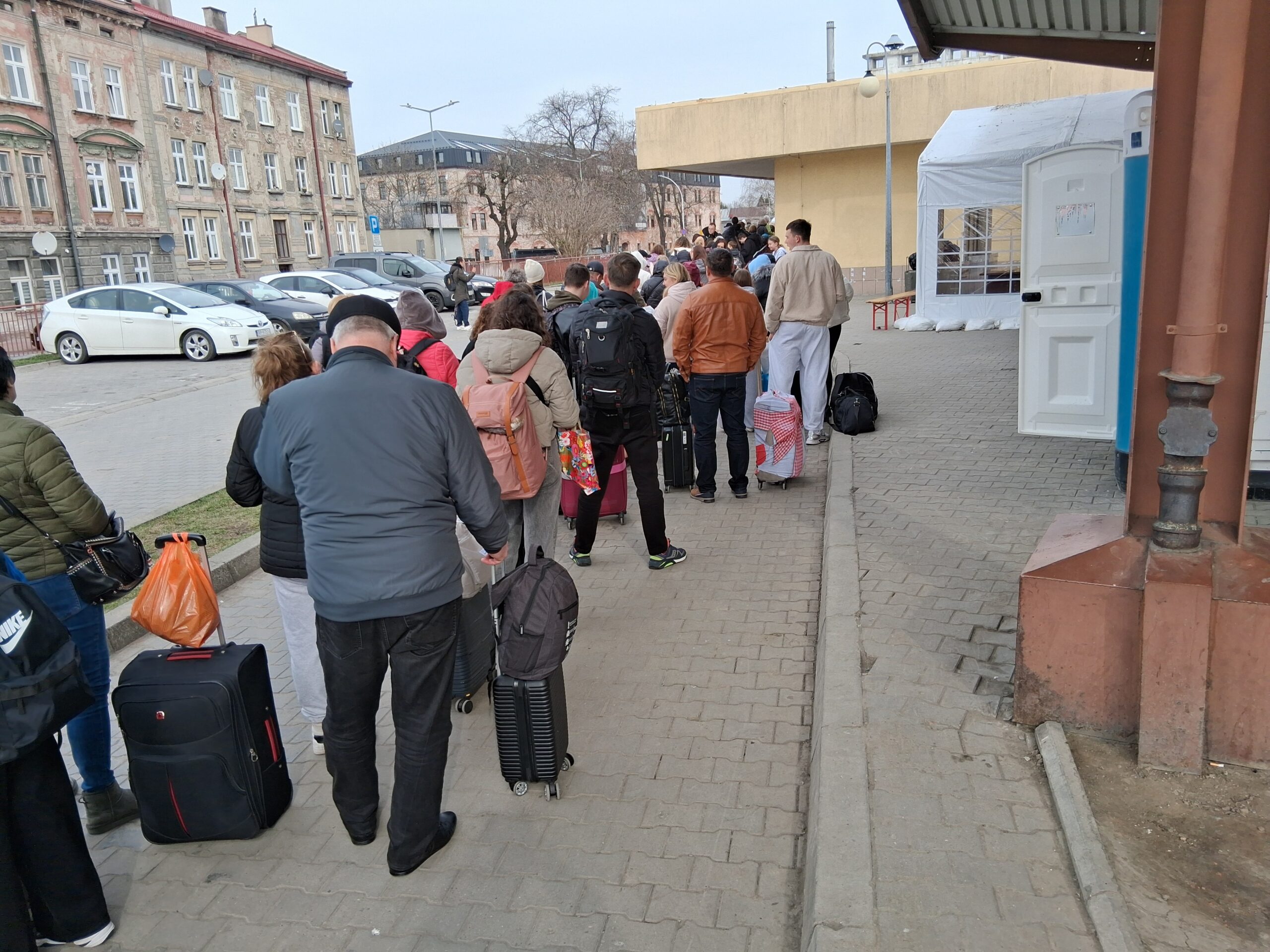

It’s not easy to get into Ukraine. You can access the country through Moldova, Romania, Hungary, and Slovakia but Poland’s Warsaw is the most direct route. Commercial flights have all been canceled since the start of Russia’s main invasion in 2022. Kyiv’s international airport was one of the first targets. Yet direct trains between Warsaw and Kviv are few, and typically involve overnight passage. Wanting to go to Lviv on March 30 and arrive the same day meant changing trains in Krakow and again at the border town of Przemyśl.
At Przemyśl you drag your bags from one station across the border through passport control to another. Consider it also a walk back in time. The entire exercise is a relic of 19th century politics. The Austro-Hungarian empire, then encompassing parts of Poland, built “standard gauge” tracks of 1435mm. The Russian empire built wider tracks, originally 1524mm, later adjusted to 1520mm during the Soviet era. The different track gauges certainly paid off in 1941 to slow the Nazi advance. Today, the tiresome exercise still takes hours and long lines.
Waiting to enter passport control at Przemyśl.
It’s nice to get special attention. Once the train arrived at Ukraine customs in Shehyni the border guards gave me plenty. The English-speaking officer didn’t seem particularly impressed that I came to Ukraine to show my movies. I was hoping he’d inquire further and I could unfurl my giant VJH posters that I took the trouble to bring. But no. He was interested in what was in my suitcase, asking me if I had drugs like marijuana. No sir. Is this a standard question for Americans? Are we all considered potheads? Later, I started wondering if the illicit drug market was booming in Ukraine because of the war. Those drugs might come in handy for a populace facing PTS and Vets suffering debilitating injuries.
Dutifully, I dug my giant bag out of the storage locker underneath the bottom bunk. Of special interest were my pills. I’m not sure he knew the word melatonin but he wasn’t moved. He questioned me about all the identical vials, once used to store finger sticks for testing blood sugar, each now possessing its own hand-written label. I revealed ibuprofen and Tums. At that point he lost interest, graciously offering to help repack. Later, I was relieved not to have stumbled on the painkillers for my back, their names long forgotten.
People go to work. Drink beer. Complain about customer service. Worry about traffic. Argue about politics. Raise children. Plan futures. And maybe score illicit drugs.
All of it inside a country at war.
Arriving late in Lviv, I went out to the curb, and proceeded to become completely disoriented due to almost complete darkness. Were the lights out because of potential bombs? Was there another recent attack on the power grid?
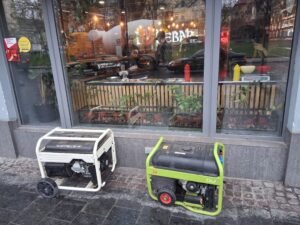
generators standing by for immediate service outside a kebab shop
Trying and failing to get my Uber app to work, I gave up and went back inside. The gruff blond with Princess Leia curls behind the information desk didn’t visibly groan when she saw me coming. That encouraged me. This was now the third time I probed her services. Without her help I never could have changed money or bought my ticket to Kyiv. At 11pm she seemed to be the only person around who spoke English. Using her own phone she booked me a ride on “Bolt,” writing down the car type, license plate, and cost, and told me to get my ass out there. She pegged me for a nincompoop and rightly so.
Exhausted, I was nonetheless grateful.
The longer I stayed in Ukraine, through countless small interactions, the more I noticed subtleties. Maybe it’s how war reveals character. Maybe directness is just the Ukrainian way. No time to waste! Get to the point! Though I hardly experienced hurriedness, much less rudeness, most service people were all business – punctilious, and painfully so for this free-spirited soul-farer. My train ride to Kyiv three days later was a case in point.
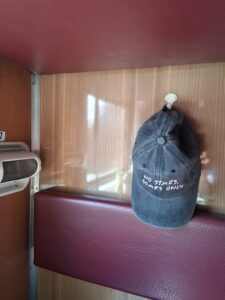 My compartment companion was a successful young businessman returning home, an importer of New Age products: supplies for meditation, yoga, massage, and overall well-being. The Gwyneth Paltrow of Ukraine. Maybe Goop will someday buy his booming business. The cap he hung on the wall struck me as an incredibly good omen. It encapsulated much of what I know to be true about Vets: “No Stars, Just Scars.” I asked him if I might take a photo of it. He said sure, then gifted it to me.
Serhey’s English was wonderful due to his regular international travel. He indulged me my favorite pastime and we had long existential conversations. Turns out he had an apartment in the burbs not far from our Kyiv hotel. Me and my friend Ben, who flew in from Thailand to come along for the ride, later had dinner with him and his wife, and they took us to a grocery store for late night shopping. Completely apropos of our first conversation, Serhey’s now reading the final draft for my forthcoming book on Collapse. Turns out the collapse of modern industrial civilization is not a subject that frightens Ukrainians. At least Serhey – a mensch and a friend.
We were comically assisted on the ride by the train itself – a Soviet-era relic that probably dated to WWII. The car was hot, crazy hot. Boarding in Lviv, dressed appropriately for winter, I was wearing multiple sweatshirts and my leather jacket. But I was also forced to since I couldn’t fit them in my bag. In short order, layer after layer came off. Serhey soon stripped down to his t-shirt and shorts, propriety be damned. I was sorry my swimsuit lay buried in my bag. I couldn’t understand how it could be so hot. On the first of my many trips to the bathroom, I discovered why.
Like U.S. trains of old, the toilet opened directly onto the tracks below, providing a cool blast of fresh air, though not where it was most needed. Given 335 miles of human waste deposits you’d think you might catch fleeting glimpses of sprouting mushrooms but the urine must keep the growth under control. I would’ve taken a photo but I was afraid I’d drop my phone down the chute of no return.
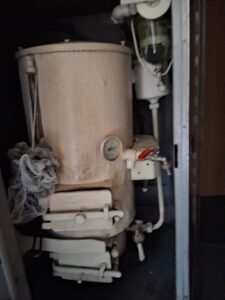
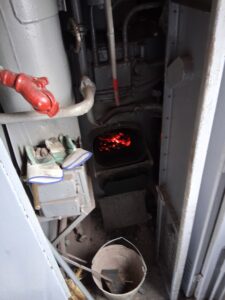 At the end of the car, I found the culprit – a large, well-fed coal burning furnace. The door was open, waiting for more fuel. On the other side of the furnace was a samovar – a giant, old Ukrainian tea kettle. I tried the handle. No go. But each car came with an attendant, posted in a closet-sized compartment next door, ever ready to sell tea, snacks, water and coffee. She seemed to have stepped fully clothed out of a 19th century novel by Dostoevsky. Her devotion to feeding the furnace was peerless. Like a frenzied spectre from the Russian winter of 1812 she kept us warm alright.
 When it came time to schedule the reverse trip, to square away plans to get to Athens to meet my partner Maggie, I thought doing it 5 days in advance would allow plenty of time. Wrong. I thought it was difficult to get INTO Ukraine; turns out it’s far more difficult to get OUT.
When opened for sale, the Kyiv-Warsaw trains are sold out within 3 minutes – 20 days before departure. And they’re all sleeper cars, so unless you book out the entire three person compartment you can end up with a middle or top bunk where you’ll be sandwiched for 14 hours, unable to sit up. Each bunk has maybe 12 inches of clearance between your nose and your neighbor.
The buses are worse. The Warsaw trip takes up to 20 hours, six more than the train. If it’s full, and you haven’t had the foresight to buy the seat next to you, you could be in for a very long ride with a brand new best friend. Bus passengers, I’m told, receive far more scrutiny at the border.
I immediately texted Maggie. “Not to worry, but I might be delayed getting to Athens. Maybe a week or so.”
I thought about returning to Odesa, crossing the border to Moldova, then taking the train to Bucharest to fly out. But Moldova was facing its own hybrid warfare with Russians fomenting dissension, bombing supply and trade routes, and disrupting the energy grid. If anyone still questions whether Putin is making war against the west they should poll other close neighbors: Moldovans, Poles, and those in the Baltic and Scandinavian countries.
I appealed immediately to the two Ivans for help – my host Ivan S. and my “fixer” Ivan O. (Two of the four Ivans I met on the trip.)
Ivan O. texted the next morning to offer to drive us to the station. I had no idea what took place behind the scenes, but I was thinking along the same lines – let’s go there and see what we can do.
Once we found the proper ticket counter – off to the side of the official counter featuring nothing but barred windows, behind a closed door – I secured my coveted prize – a ticket out on the date I wanted, riding on the top bunk. I was WAY too late to hope for a lower bunk, much less an entire compartment. Apparently, Ivan S. had called someone and pulled strings. The Warsaw train didn’t have a single seat available either the day before or after. I was lucky. Wanting a ticket for 5 days hence Ben was forced to buy a seat on the bus. The saving grace? The costs involved for train or bus were laughably negligible. Prices for “socially significant goods” are strictly regulated to insure against wartime profiteering. I tip my hat to that.
Once on the train, it was impossible to penetrate the top bunk. I couldn’t stabilize myself on the rickety fold out ladder to crease my torso in two and wedge into the gap. Think anchovies, climbing back into the can and rolling the metal lid over. My generous and helpful compartment mate volunteered to swap, affording me the still challenging but manageable coffin in the middle. The woman with the coveted bottom bunk was also kind and let me use the little foldout chair and table, occasionally allowing me to sit down and decompress my spine.
The hallway wasn’t much better. Given my height, I couldn’t bend down enough to look out the window. It was too narrow. Stretching my legs meant being forced to stare down at the adjacent track. So much for the romance of train travel. Half the windows didn’t open to allow for fresh air. Over-heated train cars again! For many Ukrainians, given how they spent the last months freezing through a brutal and dark winter without electricity courtesy of Comrade Putin, I’m sure the warmth was welcome.
The scheduled 14 hour trip took 17 as we stopped inexplicably in the middle of the night near the border and sat on the tracks for 2 hours. My bunk donor, peacefully snoring above me, was roused around 4 by Ukrainian border police. Forced to produce multiple documents along with his passport, they questioned him intensely. Later he explained that being a male of draft age – mid-30s – he was considered a potential draft dodger. He had to prove to them that his job in the agriculture sector was granted protected status by the government. Only after his explanation did I register how we were two of the only males in the whole car, otherwise packed with women and children.
I can only wish I had a copy of the photo the Polish border guard took of my face a few hours later when he roused me from my bunk to make me stand and pose. He tried but couldn’t get the angle right beforehand with me proffering my stupored head cockeyed out over the ledge.
I tried to buy morning coffee from the car attendant but he didn’t take credit so I ended up giving him a single US dollar. A word to the wise: don’t try to order decaf coffee anywhere in Ukraine but the best hotels and restaurants. Most people will look at you like you just pooped on their tablecloth. Though likely twice what my coffee would have cost with local currency, $1 was still a deal by any standard. My last 20 hyrvinia bill (50 cents) I had given to a distraught, elderly woman begging in the subway.
That was rare. Though I also saw a young couple or two bedding down in another subway underpass, encountering beggars or homeless people was uncommon. Ukraine still maintains a strong social welfare system despite the war. What typically tears Ukrainian families apart is not money but the need to get their children to safety, whether to cities further west or out of the country altogether, like my Dnipro translator whose wife returned to Russian occupied Donetsk to care for elderly parents while he was on his own to raise their two daughters.
The practice of socialized medicine, along with other social safeguards, though stressed and not up to Western European standards, are strong, far surpassing U.S. standards. That sense of both social and filial responsibility is extremely strong and something very much for Ukrainians to be proud of.
“I am my brother’s keeper,” are words in Ukraine that still carry promise.
[For the next blog in the Ukraine series, click here.]
To subscribe and receive all our blogs, film giveaways, public talks, and more, click here.