

I didn’t expect much going to Kamianka, the small city of roughly 15,000 where my grandfather Morris Kaplan was born either in 1892 or 1894. He was then known as Moishe Kapitman or Moishe Kapolman. But the visit became one of the richest experiences of my journey through Ukraine.
 Nestled in a small valley where the vast central Ukrainian steppes suddenly fall away, Kamianka is wrapped around the winding Tiasmyn River. The landscape feels almost improbably serene: fertile farmland stretching endlessly in every direction, fruit trees blooming across residential streets, and soft hills protecting the town from the harshest winter winds.
This was the home of my mother’s parents, and their parents, going back generations.
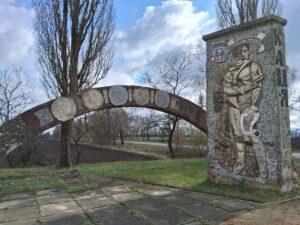
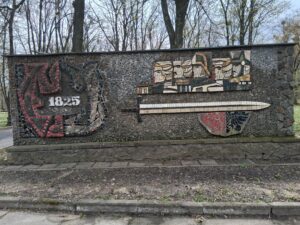
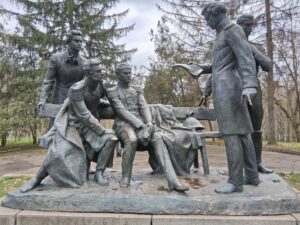 The town itself carries deep cultural and historical significance. Kamianka is known as an artistic and intellectual refuge dating back to the early 19th century. A large park honors the Decembrists, Russian military officers and intellectuals who attempted to overthrow the Czar in 1825 and abolish serfdom and feudalism. The park also celebrates Alexander Pushkin and Pyotr Ilyich Tchaikovsky, both of whom spent time here.
 Tchaikovsky’s sister Aleksandra Davydova lived on a large estate in Kamianka, where many of the Decembrist plotters gathered. Tchaikovsky himself spent extended periods there composing some of his masterpieces. In one letter written during the summer of 1880, he described the town this way:
“I regained peace in my soul, which I vainly sought in Moscow and St. Petersburg.”
In another passage, he wrote:
“I experienced a minute when I was standing amidst a wheat field, which is adjacent to the garden, and was so stunned with delight that I kneeled and thanked God for the depth of the bliss, which I had never felt before. Beauty and space are everywhere.”
Standing there more than a century later, I understood exactly what he meant.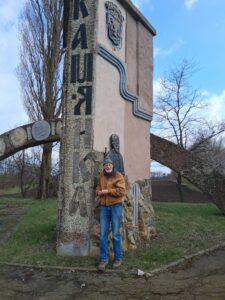
Beneath the beauty lies another history, one less acknowledged, and not immediately apparent.
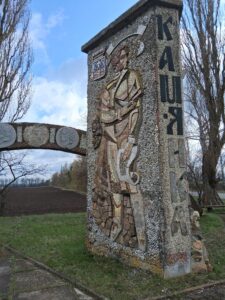 Founded in the early 1800s, Kamianka once supported a thriving Jewish population. By the late 19th century, up to five thousand remained in what was basically a Jewish town. Like so many shtetls across Eastern Europe, Jewish life was deeply woven into the fabric of the town itself. Jewish families built and maintained businesses, schools, homes, and cultural institutions.
We met with Yuri, the local historian and director of the town museum. The museum itself was under reconstruction, so instead he guided us through Kamianka’s Jewish cemetery, at least what remained of it. Later on I got to wondering how much of Jewish life was actually represented in that museum.
The whole experience was troubling. The cemetery today stands as an apt symbol for one of the few outward signs of Jewish life that might remain.
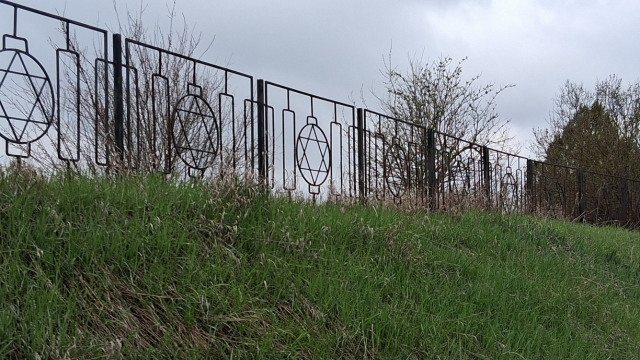
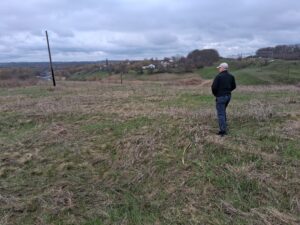 The “old” cemetery sits atop an overgrown grassy hill overlooking the valley below, completely unmarked. The earth rises in uneven humps where graves still lie buried beneath decades of neglect. Adjacent stands the “new” Jewish cemetery, fitfully enclosed by a broken fence decorated with Stars of David. Trash is discarded in the nearby trees. Some graves have clearly been maintained but many others are sinking quietly back into the earth.
There appears to be no official caretaker.
In Ukraine, the responsibility for cemetery upkeep is typically left to surviving family members. I found myself wondering how many descendants of Kamianka’s Jews travel from distant places searching for traces of their families and find nothing at all. Those that find those ancestors clearly do everything they can to spruce up the monuments, leave flowers – both living and artificial – and of course, stones – those more permanent markers of Jewish remembrance and respect.
Melancholia descended. Less due to the presence of death, which I’m used to, but because of the vacuum, the absence.
An entire civilization once existed here.
 When the topic turned to the pogroms that drove so many Jews away, and eventually toward the horrors of the Holocaust, Yuri described the perpetrators vaguely as “anarchists.” The explanation disturbed me. Pogroms were not random outbreaks of destruction and chaos, much less spearheaded by radicals seeking political change and social justice. They were carried out by ordinary “good citizens” filled with hatred for their Jewish neighbors.
Antisemitism found fertile ground in Ukraine for centuries. Apparently, that truth remains difficult for Ukrainians to fully confront even today.
In modern retellings of Kamianka’s history, Jewish life is nearly invisible. Even recent articles like this one – celebrating Tchaikovsky’s connection to the town – never mention Jews at all, despite the enormous Jewish population that once lived there alongside the celebrated cultural titans.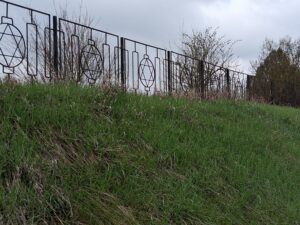
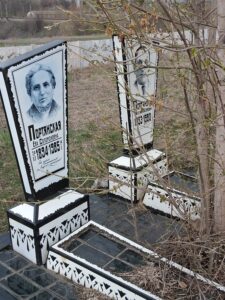
Yuri suggested that during the Soviet era remaining Jews “converted,” renouncing their Jewish heritage to become “Ukrainian,” their passports reflecting that change from “Jew” to “Ukrainian.” Of course. Though pogroms ceased under the Soviets, anti-semitism did not. But not all Jews converted. Jewish names appear on gravestones through the 70s and 80s, and into the post-Soviet era of the 1990s and beyond. Israeli genealogical records indicate that as many as 89 Jews still lived in Kamianka near the turn of the millennium.
History survives in fragments, in names, stones, memories, and mute witness. And is just as equally silenced through the revisions of conquerors.
The Holocaust finished what the pogroms started. In towns like Kamianka there often weren’t enough Jews to justify deportations to the death camps to the west. Too inefficient. Most were taken out of town and machine-gunned to death in nearby fields.
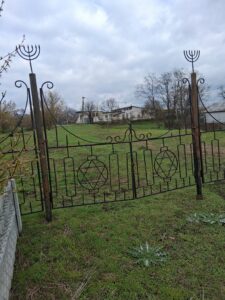 Today, what’s left is fragmented. A neglected cemetery on a hill. Broken fences with Stars of David. Graves with Jewish names that prove people held on to their heritage far longer than many care to admit. Only a few families somewhere in the world still remember where they came from. Due to the horrors, most stopped speaking about it years ago, including my own mother and her father.
I never got my grandfather to speak about his days there. It was hard enough to get him to speak about his early life in the US – where he arrived as a teen in 1910. Perhaps it’s no wonder. Pogroms and persecution driving him from his homeland alone, trying to survive in sweatshops on 15 cents a day once in the U.S. Even though her mother too came from Cherkasy Oblast, the region that contains Kamienka, my mother grew up with a vacuum for history. And so it was for us, her three kids. It was literally days before my trip to Ukraine that I finally even confirmed that both grandparents emigrated from there. Before then Ukraine was just an unconfirmed rumor of our family history.
It saddened me inexpressibly. What a wonderful civic life I imagined the citizens of Kamianka must’ve had and could’ve continued without the perpetual interference of their “good Christian neighbors.” Everything they needed was at their doorstep. Fertile farmland that stretches forever, abundant apricot and other fruit trees, bountiful flowing water, a nestled valley protected from bitter winds, and, it goes without saying with Jews, good schools and a rich cultural life.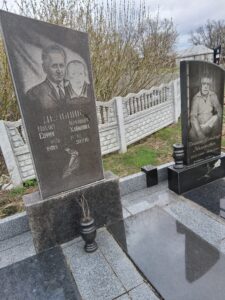
Walking through Kamianka I kept thinking about how full life must have been. I understand why people stayed for generations.
At some point the visit ceased to be about genealogy and became more unsettling. Standing in that cemetery, looking over the beautiful valley where my grandfather was born, I felt both connected to the place and heart-stricken at how much had been erased.
[For the next blog in the Ukraine series, click here.]
To subscribe and receive all our blogs, film giveaways, public talks, and more, click here.